JBL PartyBox Stage 320 vs Sony ULT Tower 5 (2026)
Sony's ULT Tower 5 is the better pick for most people, with powerful bass, pro inputs and a lighter body. JBL's Stage 320 wins if you roll your speaker around a lot.
Head-to-head comparison · Research-based · Affiliate links
We earn a commission from qualifying purchases made through our links, at no extra cost to you. It never decides our picks. As an Amazon Associate I earn from qualifying purchases. How we make money
Sony ULT Tower 5 vs JBL PartyBox Stage 320: which one should you buy?
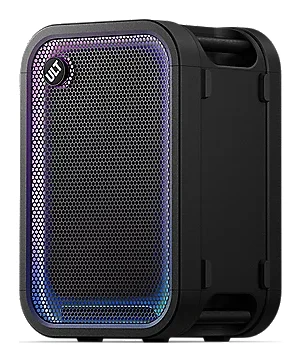
Best for: DJs and karaoke hosts needing XLR inputs and deep bass
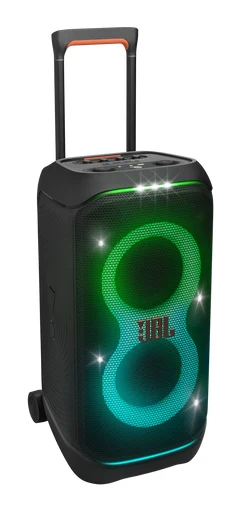
Best for: Frequent party hosts who want a wheeled speaker with swappable battery
The JBL PartyBox Stage 320 vs Sony ULT Tower 5 matchup is close on paper, but most shoppers should pick the Sony ULT Tower 5: it is the budget-tier option, it is lighter, and it has the wider set of inputs, including XLR and USB-C. The JBL PartyBox Stage 320 is the better choice if you move your speaker often and want wheels, a telescopic handle, a swappable battery and dual 1/4" mic and guitar inputs.
Both are big party speakers with built-in lighting, IPX4 splash resistance and Auracast linking. Where they differ is in how you carry them, what you plug into them and how they deliver bass.
JBL PartyBox Stage 320 vs Sony ULT Tower 5: sound and bass
Sony builds the ULT Tower 5 around bass. It has a 230 mm circular woofer with ULT DUCT, two approx. 60 mm tweeters in a 2-way bass reflex design, and a rated output of up to 300 W. The front ULT button switches between four sound modes (ULT1, ULT2, FLAT and LIVE). The Sony Sound Connect app adds a 10-band custom EQ, and Sound Field Optimization is also listed. Sony gives a frequency response of 20 Hz - 20,000 Hz. Reviewers praise the deep, powerful bass, though a common criticism is that it can overwhelm in a normal living room. The speaker also has no 360-degree sound.
JBL takes a different route. The PartyBox Stage 320 uses two 6.5" (165mm) woofers and two 25mm dome tweeters for what JBL calls JBL Pro Sound. Output is rated at 240 W RMS. Sony's figure is stated as "up to 300 W", so the two numbers use different wording and shouldn't be treated as a like-for-like loudness gap. JBL lists a frequency response of 40Hz - 20kHz (-6dB). Reviewers say it gets loud enough to fill big rooms and yards, and they credit AI Sound Boost with keeping sound clean at high volume. The criticisms are that the front-facing design weakens sound off to the side, and that bass compression and harshness show up at maximum volume.
Who wins: the Sony, for people who want powerful bass and more ways to shape it with modes and EQ. The JBL suits hosts who want a big-room, bass-heavy sound and mostly point the speaker at the crowd. Keep the room size in mind, since reviewers say the Sony's bass can overwhelm in a normal living room.
Inputs for DJs, karaoke and guitar
This is the clearest split. The Sony lists XLR in, XLR out, RCA in, USB-A, USB-C and a 6.3 mm mic input. That is the connection set of a speaker meant to sit in a DJ or karaoke rig, and reviewers specifically praise the range of connections. Sony doesn't list a guitar input.
The JBL lists 2 x 1/4" mic/guitar inputs, a 3.5mm aux in and USB. Reviewers like the dual 1/4" inputs and the karaoke EQ tuning, and the speaker suits guitarists and duet singers because both inputs take either a mic or a guitar. The trade-off, which reviewers raise, is that it has no XLR or USB-C input.
Who wins: the Sony for DJs, anyone with a mixer or XLR gear, and single-mic karaoke. The JBL for a guitar-and-vocals setup or two singers at once.
Portability and battery
The Sony weighs approx. 12.7 kg and has four carry handles but no wheels, so it must be carried. The JBL weighs 16.5 kg, which reviewers call big and heavy even with wheels. It does have a telescopic handle and wide wheels, which make it easy to roll. If you are moving it from car to party every weekend, the JBL's rolling design matters more than the weight difference on paper. If you mostly lift it into a room and leave it, the Sony's lower weight wins.
Battery life is close. Sony rates the ULT Tower 5 at up to 20 hours (ULT on, Vol. 16, lighting off), dropping to about 12 hours with lighting on. A 10-minute charge gives about 100 minutes of playback. JBL rates the Stage 320 at up to 18 hours, and a 10-minute fast charge gives 2 hours. A full charge takes 3 hours. JBL doesn't list the volume or lighting conditions behind its 18-hour figure. The JBL's real advantage is that the battery (JBL BATTERY400, Li-ion 68Wh) is replaceable, so you can swap in a second one to keep going. Sony doesn't list a swappable battery.
Both carry an IPX4 rating. Sony specifies it applies only when the speaker is vertical with the port cover closed. JBL lists IPX4 for outdoor splash resistance without that condition in its specs.
Who wins: the JBL for frequent movers and long events where a spare battery helps. The Sony for lighter lifting and slightly longer rated runtime with the lights off.
Bluetooth and multi-speaker linking
The Sony lists Bluetooth 5.3 with SBC, AAC and LDAC, plus multipoint and Fast Pair. Its Party Chain via Auracast links up to 100 compatible Sony speakers, and Stereo Pair handles left and right channels. It also has three lighting presets: Beat, Wave and Mellow.
The JBL has the newer Bluetooth 5.4, but JBL doesn't list supported codecs or multipoint. It offers Auracast multi-speaker linking and stereo pairing through the JBL PartyBox app. Its lightshow has starry lights, trails and strobe effects synced to the beat. JBL doesn't give a maximum number of linked speakers.
Who wins: the Sony on published detail, especially if you care about LDAC or want to link a lot of speakers. Both are fine for a simple stereo pair or a small group of linked speakers.
What experts say
Reviewers rate the Sony ULT Tower 5 very highly. TechRadar gave it 5/5, Tom's Guide 5/5 and Trusted Reviews 4.5/5, for an expert average of 9.7 out of 10. The praise centres on the deep bass, the wide connectivity, Bluetooth 5.3 with LDAC, multipoint and Fast Pair, the lighter weight and the battery life. The main criticisms are the lack of wheels or a telescopic handle, the upright-only IPX4 protection, no 360-degree sound and bass that can overwhelm in a living room.
The JBL PartyBox Stage 320 is also well regarded, but with a lower expert average of 8.1 out of 10. SoundGuys scored it 8.2/10 and Tom's Guide gave it 4/5. It is recommended in 3 expert guides. Reviewers praise the wheels and telescopic handle, the replaceable battery, the dual 1/4" inputs, the volume and AI Sound Boost. They criticise its size and weight, the weaker sound off to the side, the bass compression and harshness at maximum volume, and the lack of XLR or USB-C.
Tom's Guide scored both, giving the Sony 5/5 and the JBL 4/5, so on that one shared review the Sony came out ahead.
Choose the JBL PartyBox Stage 320 if…
Best for: Frequent party hosts who want a wheeled speaker with swappable battery
Choose the JBL PartyBox Stage 320 over the Sony if you move your speaker often and want wheels, a telescopic handle and a swappable battery. It also suits guitar players and singers who want dual 1/4" inputs and a big-room, bass-heavy party sound.
Read our full JBL PartyBox Stage 320 review →- Battery life
- up to 18 hours (10-minute fast charge gives 2 hours)
- Drivers
- 2 x 6.5" (165mm) woofers, 2 x 25mm dome tweeters
- Bluetooth
- 5.4
- Water resistance
- IPX4
- Weight
- 16.5 kg / 36.38 lbs
- Dimensions
- 335 x 669 x 385 mm (13.19" x 26.34" x 15.16")
Reasons to buy
- Wheels and telescopic handle make it easy to roll around
- Replaceable battery with up to 18 hours of play time
- Dual 1/4" mic and guitar inputs with karaoke EQ tuning
- Gets loud enough to fill big rooms and yards
- AI Sound Boost keeps sound clean at high volume
Reasons to avoid
- Big and heavy at 16.5 kg even with wheels
- Front-facing design weakens sound off to the side
- Bass compression and harshness at maximum volume
- No XLR or USB-C input
- SoundGuys
- 8.2
- Tom's Guide
- 8.0
- Stereo Guide
- 9.3
Pick the JBL if you host often and move your speaker around, because the wheels and telescopic handle are the biggest practical advantage here. It is also the better fit for guitarists and singers who want dual 1/4" mic/guitar inputs, and for long events where a replaceable battery lets you keep the music going. Accept that it is the premium-tier option, that it is heavy at 16.5 kg, and that it has no XLR or USB-C input.
Choose the Sony ULT Tower 5 if…
Best for: DJs and karaoke hosts needing XLR inputs and deep bass
Choose the Sony ULT Tower 5 over the JBL if you want a lighter speaker with pro-style inputs like XLR and USB-C for DJ or karaoke use. It also offers a longer rated battery life and a more budget-friendly price tier.
Read our full Sony ULT Tower 5 review →- Battery life
- up to 20 hours (ULT on, Vol. 16, lighting off); about 12 hours with lighting on
- Drivers
- 1 x approx. 230 mm (9.1 in) woofer, 2 x approx. 60 mm (2.4 in) tweeters, 2-way bass reflex
- Bluetooth
- 5.3 (SBC, AAC, LDAC; multipoint, Fast Pair)
- Water resistance
- IPX4 (only when vertical with the port cover closed)
- Weight
- approx. 12.7 kg (28 lb)
- Dimensions
- approx. 358 mm x 534 mm x 280 mm (14.1 in x 21.1 in x 11.1 in)
Reasons to buy
- Deep, powerful bass from a 230 mm woofer and ULT DUCT
- Wide connectivity: XLR in/out, RCA, USB-C, USB-A and 6.3 mm mic
- Bluetooth 5.3 with LDAC, multipoint and Fast Pair
- Lighter at about 12.7 kg, with four carry handles
- Up to 20 hours of battery; 10-minute charge gives about 100 minutes
Reasons to avoid
- No wheels or telescopic handle, so it must be carried
- IPX4 protection only applies when upright with the port cover closed
- No 360-degree sound
- Bass can overwhelm in normal living rooms
- TechRadar
- 10.0
- Trusted Reviews
- 9.0
- Tom's Guide
- 10.0
- Stereo Guide
- 9.1
Pick the Sony if you want deep bass, a lighter speaker and the widest connections, including XLR in and out, RCA, USB-C, USB-A and a 6.3 mm mic input. It suits DJs and karaoke hosts, and it comes in at the budget tier of this pair. It also gives you LDAC, multipoint and an app EQ. Just be ready to carry it, since it has no wheels, and keep it upright and covered if you expect splashes.
Compare our picks side by side
The specs most of our picks share, from each maker’s spec page (— = not published). Expert score = the average of published expert reviews, which rate each product for its price. Scroll sideways on small screens.
| Spec | Sony ULT Tower 5 | JBL PartyBox Stage 320 |
|---|---|---|
| Best for | Our Pick | The Alternative |
| Expert score | 9.5 | 8.5 |
| Price vs. these picks | Lower | Higher |
| Battery life | up to 20 hours (ULT on, Vol. 16, lighting off); about 12 hours with lighting on | up to 18 hours (10-minute fast charge gives 2 hours) |
| Drivers | 1 x approx. 230 mm (9.1 in) woofer, 2 x approx. 60 mm (2.4 in) tweeters, 2-way bass reflex | 2 x 6.5" (165mm) woofers, 2 x 25mm dome tweeters |
| Bluetooth | 5.3 (SBC, AAC, LDAC; multipoint, Fast Pair) | 5.4 |
| Water resistance | IPX4 (only when vertical with the port cover closed) | IPX4 |
| Weight | approx. 12.7 kg (28 lb) | 16.5 kg / 36.38 lbs |
| Dimensions | approx. 358 mm x 534 mm x 280 mm (14.1 in x 21.1 in x 11.1 in) | 335 x 669 x 385 mm (13.19" x 26.34" x 15.16") |
| Output | up to 300 W | 240 W RMS |
| Ports | XLR in, XLR out, RCA in, USB-A, USB-C, 6.3 mm mic input | 2 x 1/4" mic/guitar inputs, 3.5mm aux in, USB |
| Where to buy | View on Amazon | View on Amazon |
The verdict
For most people the Sony ULT Tower 5 is the stronger pick: reviewers score it higher, it costs less, it weighs less, and it has the richer input and Bluetooth feature set. The JBL PartyBox Stage 320 is the right answer for a narrower group, namely frequent party movers and guitar players who value wheels, a swappable battery and dual 1/4" inputs over everything else.
Ready to buy?
 Our PickSony ULT Tower 5View on Amazon
 The AlternativeJBL PartyBox Stage 320View on Amazon
Frequently asked questions
Is the Sony ULT Tower 5 better than the JBL PartyBox Stage 320?
For most people, yes. The Sony ULT Tower 5 has a higher expert average (9.7 vs 8.1 out of 10), a lighter body at approx. 12.7 kg and a wider range of inputs. The JBL PartyBox Stage 320 is better if you need wheels, a telescopic handle, a replaceable battery or dual 1/4" mic/guitar inputs.
Which has longer battery life, the JBL PartyBox Stage 320 or the Sony ULT Tower 5?
The Sony ULT Tower 5 has the longer rated battery life at up to 20 hours (ULT on, Vol. 16, lighting off), against up to 18 hours for the JBL PartyBox Stage 320. Sony's figure falls to about 12 hours with lighting on. The JBL's battery is replaceable, so a spare can extend a party.
Can I plug a guitar into the JBL PartyBox Stage 320 or the Sony ULT Tower 5?
The JBL PartyBox Stage 320 is the one built for it, with 2 x 1/4" mic/guitar inputs and karaoke EQ tuning. The Sony ULT Tower 5 lists a 6.3 mm mic input, XLR, RCA, USB-C and USB-A, but Sony doesn't list a guitar input.
Which is easier to move, the JBL PartyBox Stage 320 or the Sony ULT Tower 5?
The JBL PartyBox Stage 320 is easier to move over distance because it has wheels and a telescopic handle, although it weighs 16.5 kg. The Sony ULT Tower 5 is lighter at approx. 12.7 kg with four carry handles, but it has no wheels and must be carried.
Do the JBL PartyBox Stage 320 and Sony ULT Tower 5 support multi-speaker linking?
Yes, both do. The Sony ULT Tower 5 supports Party Chain via Auracast with up to 100 compatible Sony speakers, plus Stereo Pair. The JBL PartyBox Stage 320 offers Auracast linking and stereo pairing through the JBL PartyBox app, but JBL doesn't list a maximum number of speakers.
Are the JBL PartyBox Stage 320 and Sony ULT Tower 5 waterproof?
Neither is waterproof, but both are rated IPX4 for splash resistance. Sony states the ULT Tower 5's IPX4 applies only when the speaker is vertical with the port cover closed. JBL lists IPX4 for the PartyBox Stage 320 for outdoor splash resistance.
Sources
Specs are taken from the manufacturers' official pages; expert recommendations from the publications below.
- Sony ULT Tower 5: helpguide.sony.net, techradar.com, tomsguide.com, stereoguide.com
- JBL PartyBox Stage 320: jbl.com, global.jbl.com, mm.jbl.com, fullspecs.net
More buying guides
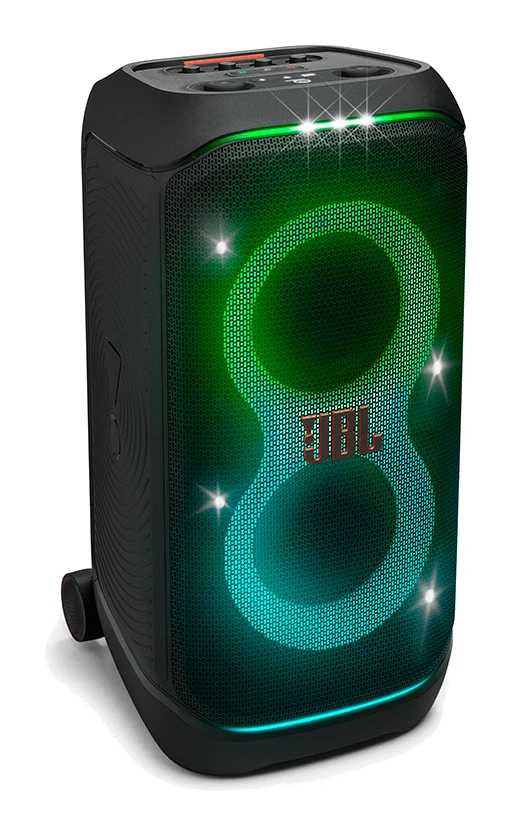
JBL PartyBox Stage 320 Review (2026): Built for Hosts
A look at the JBL PartyBox Stage 320: loud, bass-driven sound, a replaceable battery, mic and guitar inputs and Auracast linking, plus the size and weight trade-offs.
Published Oct 23, 2026Sony ULT Tower 5 Review (2026): Big Bass, Flexible Inputs
A look at the Sony ULT Tower 5 party speaker: its bass-heavy sound, DJ and karaoke inputs, battery life and the trade-offs in weight, weather resistance and 360-degree sound.
Published Nov 4, 2026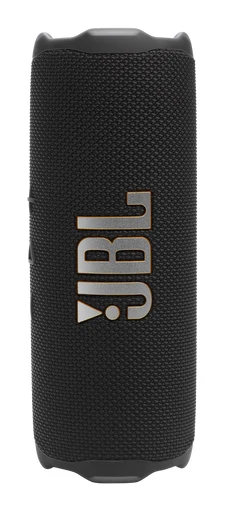
JBL Flip 7 Review (2026): Tough, Punchy and Mono
The JBL Flip 7 is a rugged, mid-range portable Bluetooth speaker with Auracast and lossless USB-C audio. Here is what the specs and expert reviews say about it.
Published Oct 30, 2026