Flashforge Adventurer 5M vs Creality SPARKX i7 (2026)
The Creality SPARKX i7 is the better pick for most beginners, while the Flashforge Adventurer 5M wins on speed and networking. Here is how they compare.
Head-to-head comparison · Research-based · Affiliate links
We earn a commission from qualifying purchases made through our links, at no extra cost to you. It never decides our picks. As an Amazon Associate I earn from qualifying purchases. How we make money
Creality SPARKX i7 vs Flashforge Adventurer 5M: which one should you buy?
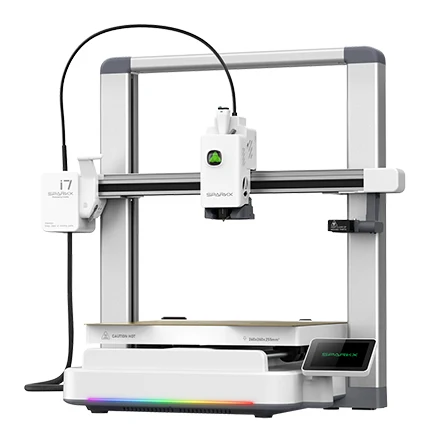
Best for: Beginners wanting camera monitoring and an easy multicolor upgrade path
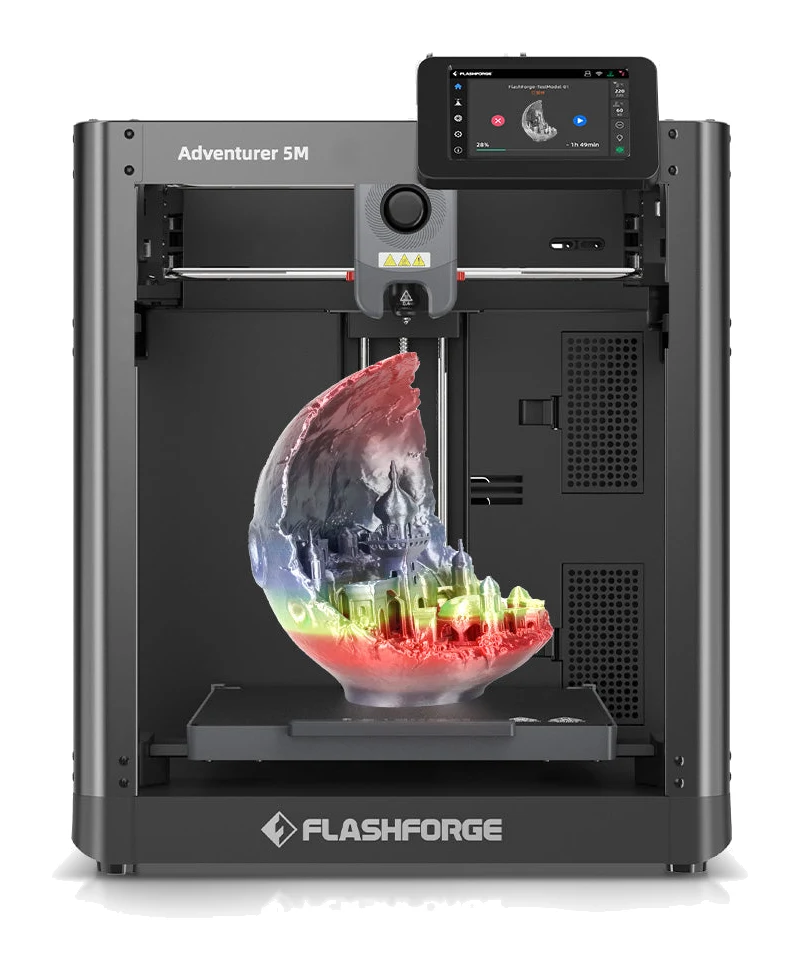
Best for: Schools and tinkerers wanting fast, networked single-color printing
The Creality SPARKX i7 is the better choice for most buyers in the Flashforge Adventurer 5M vs Creality SPARKX i7 matchup: it has a larger build plate, a built-in AI camera, an optional four-color upgrade and a lower price tier. The Flashforge Adventurer 5M is the better choice if you care about raw speed, wired Ethernet and the freedom to run any filament brand, as in a classroom or a small print farm.
Both are open-frame, direct-drive printers that are nearly pre-assembled, so the decision comes down to what you value most. Neither is a clear winner on everything.
Speed and motion: Flashforge Adventurer 5M comes out ahead
The Adventurer 5M is the faster machine on paper. Flashforge lists a 600mm/s maximum print speed and 20000mm/s² acceleration, on a CoreXY all-metal frame with vibration compensation. The SPARKX i7 tops out at ≤ 500 mm/s and ≤ 10000 mm/s². Acceleration is where the gap is widest: the Flashforge's figure is double the Creality's.
Reviewers say the same. Lower top speed and acceleration than the Flashforge is a common criticism of the SPARKX i7, while the Adventurer 5M's faster CoreXY motion is one of its most praised traits.
The SPARKX i7 isn't slow, though. It has input shaping and pressure advance, and it prints at up to ≤ 500 mm/s. Even so, the Adventurer 5M is the faster machine on paper, while the SPARKX i7 trades some speed for a larger build volume, a camera and a multicolor upgrade path.
Heat-up is another point. Flashforge says its direct-drive nozzle reaches 200°C in 35 seconds, and the Creality sheet doesn't give a comparable figure. The SPARKX i7 does reach a higher nozzle limit, ≤ 300 °C against the Flashforge's 280°C. Bed temperature is the same on both, at 100 degrees.
Build volume and materials: SPARKX i7 has more room
The SPARKX i7 has a 260 × 260 × 255 mm build plate. The Adventurer 5M offers 220 × 220 × 220 mm. That is a noticeable difference for larger single parts, and reviewers list the bigger volume as a strength of the Creality and the smaller one as a weakness of the Flashforge.
Material support is similar, with one caveat. Creality lists PLA, PLA-Silk, PETG, TPU and PLA-CF. Flashforge lists PLA and PETG on the 0.4mm nozzle, with TPU, PLA-CF and PETG-CF on the 0.6mm nozzle. Both are open-frame designs, and reviewers note that neither is well suited to ABS. Flashforge mentions an optional enclosure through DIY files, but there is no stock enclosure for ABS/ASA.
Flashforge offers 0.4mm, 0.6mm, 0.8mm and 0.25mm nozzle sizes, and the Creality is a 0.4 mm printer that is compatible with 0.2/0.6/0.8 mm nozzles. Layer height runs 0.05-0.3 mm on the SPARKX i7 and 0.1-0.4mm on the Adventurer 5M, so the Creality goes finer and the Flashforge goes coarser.
For larger prints and slightly finer detail, the SPARKX i7 comes out ahead.
Camera and multicolor: SPARKX i7 is the only one with either
This is the clearest difference. The SPARKX i7 has a 720p AI camera with lighting, plus detection for spaghetti, air-printing and tangles. Flashforge doesn't list a built-in camera for the Adventurer 5M, and reviewers name the lack of one as a drawback.
The SPARKX i7 also supports an optional CFS Lite for four-color printing, with a desiccant-sealed spool box. There are trade-offs: reviewers say single-nozzle multicolor prints waste a lot of filament as purge, and that the CFS Lite is bulky and needs its own space. The Adventurer 5M has no multicolor support at all.
If you want to leave a long print running and check on it, or you are curious about multicolor, the SPARKX i7 is the one to get. If you only ever print in one color, these extras matter less.
Setup, connectivity and everyday use
Both printers are quick to get going. Flashforge says its printer is 95% pre-assembled with up to a 10-minute setup. Creality says setup takes about 10 minutes or less. The SPARKX i7 has full-auto leveling, a tool-free quick-swap hotend, a dual-sided textured golden PEI plate and a 2.85-inch color touchscreen. It also has power-loss recovery and filament run-out resume. Reviewers praise its beginner-friendly setup, clean, consistent prints and quiet operation out of the box.
The Adventurer 5M has a larger 4.3-inch touchscreen, a flexible PEI plate for easy print removal and a filament runout sensor. Its quick-detach nozzles swap in about 3 seconds. Reviewers call its auto-leveling reliable and its PLA/PETG results good, but they describe stock print quality as average and say it needs slicer tuning.
Connectivity favors Flashforge. It has Wi-Fi, Ethernet and USB, and works with any filament brand, which suits schools and print farms. The SPARKX i7 has USB and Wi-Fi (2.4 GHz), plus 8GB of onboard storage for offline printing. Ethernet isn't listed.
For out-of-the-box results with little fiddling, the SPARKX i7 has the edge. For wired networking and tinkering with profiles, the Adventurer 5M does.
What experts say
The SPARKX i7 has an expert average of 8.5 out of 10. Tom's Hardware gave it 4.5 out of 5, CGMagazine 8.5 out of 10 and The Gadgeteer 8 out of 10. Reviewers praise the larger build volume, the AI camera, the optional CFS Lite and the easy setup. Their main complaints are the purge waste on multicolor prints, the open frame, the bulky CFS Lite and the lower top speed.
The Adventurer 5M averages 7.9 out of 10. TechGearLab scored it 68 out of 100 and Dialing In 3D gave it 4.5 out of 5. Reviewers like its fast CoreXY motion, its Ethernet, Wi-Fi and USB connectivity, its quick-detach nozzles, its filament freedom and its reliable auto-leveling. They criticize the missing camera and multicolor support, the smaller build volume, the average stock print quality and the lack of a stock enclosure. It is recommended in three expert buying guides, against one for the SPARKX i7, so it has a wider following among guide writers even though its average score is lower.
Choose Creality SPARKX i7 if…
Best for: Beginners wanting camera monitoring and an easy multicolor upgrade path
Pick the SPARKX i7 over the Adventurer 5M if you want a built-in AI camera, a larger build volume and an optional multicolor upgrade. It suits beginners who value easy setup and clean results over raw speed.
Read our full Creality SPARKX i7 review →- Weight
- 9.12 kg
- Resolution
- Layer height 0.05-0.3 mm
- Warranty
- 1 Year Limited
- Heating Bed
- ≤ 100 ℃
- Print Speed
- ≤ 500 mm/s
- Connectivity
- USB Drive/Wi-Fi (2.4 GHz)
Reasons to buy
- Larger 260 × 260 × 255 mm build volume
- Optional CFS Lite adds four-color printing with a sealed spool box
- 720p AI camera detects spaghetti, air-printing and tangles
- Nearly pre-assembled; reviewers praise fast, beginner-friendly setup
- Clean, consistent prints and quiet operation out of the box
Reasons to avoid
- Single-nozzle multicolor prints waste a lot of filament as purge
- Open frame limits it to PLA/PETG-type materials, poor for ABS
- CFS Lite is bulky and needs its own space
- Lower top speed and acceleration than the Flashforge
- CGMagazine
- 8.5
- The Gadgeteer
- 8.0
- 3D Printing Store
- 8.2
- Dial In 3D
- 8.2
- Faux Hammer
- 4.0
- Tom's Hardware
- 9.0
Choose the SPARKX i7 if you are a beginner who wants camera monitoring, a larger 260 × 260 × 255 mm build plate and an easy route to multicolor later. It is the budget option here, and reviewers praise its clean, consistent prints and quiet operation. Accept that it is slower than the Flashforge, that multicolor wastes filament, and that it isn't a good fit for ABS.
Choose Flashforge Adventurer 5M if…
Best for: Schools and tinkerers wanting fast, networked single-color printing
Pick the Adventurer 5M over the SPARKX i7 if you prioritize speed, wired Ethernet networking and freedom to use any filament brand. It fits classrooms, small print farms and tinkerers who are happy to tune profiles and don't need a camera or multicolor.
Read our full Flashforge Adventurer 5M review →- Weight
- 10.8 kg
- Resolution
- Layer thickness 0.1-0.4mm
- Warranty
- 1 year (printer), 3 months (extruder parts)
- Heating Bed
- Yes, up to 110°C
- Print Speed
- 300 mm/s
- Connectivity
- Wi-Fi; Ethernet; USB
Reasons to buy
- Faster CoreXY motion: 600 mm/s top speed, 20000 mm/s² acceleration
- Ethernet plus Wi-Fi and USB suits schools and print farms
- Quick-detach nozzles swap in about 3 seconds
- Works with any filament brand
- Reliable auto-leveling and good PLA/PETG results
Reasons to avoid
- No built-in camera or multicolor support
- Smaller 220 × 220 × 220 mm build volume
- Stock print quality is average and needs slicer tuning
- Open frame limits materials; no stock enclosure for ABS/ASA
- TechGearLab
- 6.8
- Seek & Score
- 9.7
- A Valid Review
- 8.6
- Dial In 3D
- 9.0
Choose the Adventurer 5M if speed, wired Ethernet and filament freedom matter more to you than a camera. It suits classrooms, small print farms and tinkerers who are happy to tune slicer profiles for single-color PLA and PETG work. It is the premium option here, and you give up multicolor, a built-in camera and some build volume.
Compare our picks side by side
The specs most of our picks share, from each maker’s spec page (— = not published). Expert score = the average of published expert reviews, which rate each product for its price. Scroll sideways on small screens.
| Spec | Creality SPARKX i7 | Flashforge Adventurer 5M |
|---|---|---|
| Best for | Our Pick | The Alternative |
| Expert score | 7.7 | 8.5 |
| Price vs. these picks | Lower | Higher |
| Weight | 9.12 kg | 10.8 kg |
| Resolution | Layer height 0.05-0.3 mm | Layer thickness 0.1-0.4mm |
| Warranty | 1 Year Limited | 1 year (printer), 3 months (extruder parts) |
| Heating Bed | ≤ 100 ℃ | Yes, up to 110°C |
| Print Speed | ≤ 500 mm/s | 300 mm/s |
| Connectivity | USB Drive/Wi-Fi (2.4 GHz) | Wi-Fi; Ethernet; USB |
| Build plate size | 260 × 260 × 255 mm | 220 × 220 × 220 mm |
| Maximum Resolution | 100±0.1 mm | ±0.2 mm |
| Where to buy | View on Amazon | View on Amazon |
The verdict
For most people the Creality SPARKX i7 is the better printer. It has the higher expert average, the bigger build plate, the camera and a multicolor upgrade path, all at the lower price tier. The Flashforge Adventurer 5M is the right pick if you want faster motion, Ethernet and a printer you can tune and network across several machines.
Ready to buy?
 Our PickCreality SPARKX i7View on Amazon
 The AlternativeFlashforge Adventurer 5MView on Amazon
Frequently asked questions
Is the Flashforge Adventurer 5M better than the Creality SPARKX i7?
Not for most buyers. The Creality SPARKX i7 has the higher expert average (8.5 out of 10 against 7.9), a larger build plate, an AI camera and optional four-color printing. The Flashforge Adventurer 5M is better for speed and Ethernet networking.
Which is faster, the Adventurer 5M or the SPARKX i7?
The Flashforge Adventurer 5M is faster. It lists a 600mm/s top speed and 20000mm/s² acceleration, against ≤ 500 mm/s and ≤ 10000 mm/s² for the Creality SPARKX i7.
Does the Creality SPARKX i7 have a camera?
Yes. The SPARKX i7 has a 720p AI camera with lighting and detection for spaghetti, air-printing and tangles. Flashforge doesn't list a built-in camera for the Adventurer 5M.
Can the Flashforge Adventurer 5M or SPARKX i7 print multicolor?
Only the Creality SPARKX i7 can, using the optional CFS Lite for four-color printing. Reviewers note that it wastes a lot of filament as purge. The Flashforge Adventurer 5M has no multicolor support.
Which printer has the bigger build volume?
The Creality SPARKX i7 does, at 260 × 260 × 255 mm. The Flashforge Adventurer 5M offers 220 × 220 × 220 mm.
Which is better for schools or print farms?
The Flashforge Adventurer 5M is the better fit. It offers Ethernet alongside Wi-Fi and USB, and works with any filament brand. The Creality SPARKX i7 lists USB and Wi-Fi (2.4 GHz), but not Ethernet.
Sources
Specs are taken from the manufacturers' official pages; expert recommendations from the publications below.
- Creality SPARKX i7: creality.com, tomshardware.com, fauxhammer.com, cgmagonline.com
- Flashforge Adventurer 5M: flashforge.com, shop3duniverse.com, bikmantech.com, latin.flashforge.com
More buying guides
Flashforge Adventurer 5M Review (2026): Fast and Fuss-Free
A spec-based look at the Flashforge Adventurer 5M: a CoreXY printer with auto-leveling, quick-swap nozzles and networking, held back by its open frame.
Published Oct 25, 2026Creality SPARKX i7 Review (2026): Easy Multicolor Entry
Our Creality SPARKX i7 review looks at a mid-range, mostly pre-assembled 3D printer with auto bed leveling, an AI camera and optional four-color printing, and who should buy it.
Published Nov 4, 2026Best 3D Printers for Beginners 2026: Easy to Set Up
Five beginner-friendly 3D printers compared on setup, auto leveling, build volume and monitoring, drawn from manufacturer specs and independent expert recommendations.
Published Oct 11, 2026